
Does this one polling result explain our politics?
This YouGov polling lives ‘rent free’ in my head

YouGov did some interesting polling around perceptions of place back in August 2025, which I’ve cited before. Overall, people feel more optimistic about the state of their local area than the country as a whole as shown below.
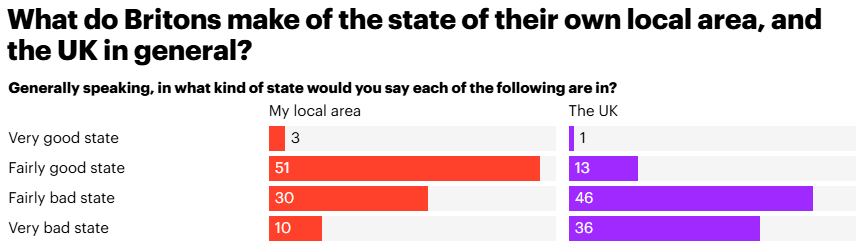
Source: YouGov
But the more you think about it, the more fascinating the results are as shown by the following charts.
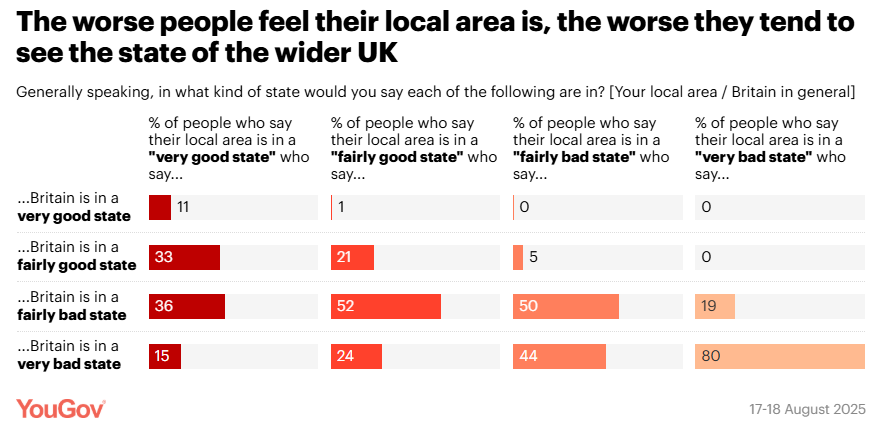
Source: YouGov
It is clear that the worse people feel about their area, the worse they feel about the state of the country. But if we focus on the final column in the chart above, then there is one certainty. If you think that your area is in a very bad state, then you are certain to also think that the country is in a bad state. That is because zero people surveyed thought that the country was doing well, if they thought their own area was in a very bad state.
If people think their area is in a bad way, do not be surprised if they think the whole country is.

Looking instead at the first column in the chart above, for people who think their local area is in a very good state, they instead have a closer to 50% chance of thinking that the whole country is in a good state.
Now this isn’t surprising given how important daily life in a place is to perceptions of the wider world. And we should always remember that correlation does not mean causation. For example, people who feel optimistic about their area could also have the same tendency across the board - and vice versa. Age, voting intention and class might also be having an effect as YouGov discuss in their blog. But the results are striking and suggest that efforts to improve the country and places need to work in tandem.
The polling also allows us to look at the breakdown by political voting intention and region.
In terms of voting intention, Reform voters were clearly the most pessimistic.
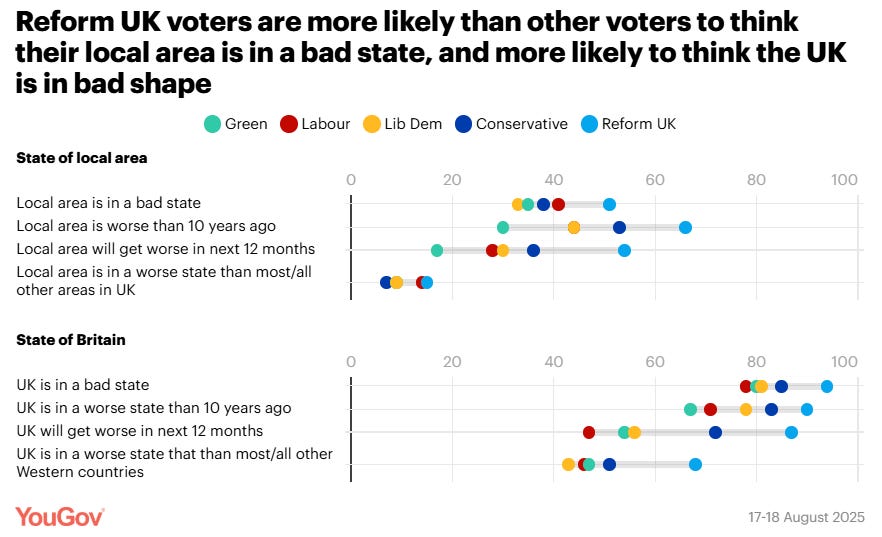
Source: YouGov
And YouGov in their writeup pointed out that despite the question being geographic, the trends did not seem that distinct at a regional level. Intrigued by this, I’ve looked a bit further into the data here.
What we can see in the data below is that people in the Midlands are the least happy about the state of their area, and also about Britain in general (though similar to the North and close to the South outside London on this metric). London is the outlier in terms of people being most happy with Britain as a whole but not by much.1
So what should we make of all these results?
Some people and places seem more dissatisfied than others, though none are particularly happy. Especially areas outside London.2
Fixing places and fixing the country must work in tandem. Positive change in places should mean thriving high streets, good jobs and housing, a sense of community and more. This must then be the basis for positive momentum at a national level.
If there is one message it is this: if people think their place is in a bad state, good luck convincing them about the country.
This also seems slightly correlated with voting intention. I’ve found the YouGov voting intention polling from the same period as their survey on area perception. People in the North, Midlands and South outside London were broadly just as likely to vote Reform as each other.
But other issues might be driving this like age or a urban/rural divide? This would particularly show up for London as the only region that is predominantly urban. As ever, further research would be great.
A fascinating read — and it does make one think about the old broken‑windows theory. Once the everyday fabric of a place starts to fray, people naturally begin to doubt the wider picture. It’s hardly surprising that some voters respond most strongly to visible decline; living with disorder tends to sharpen one’s appetite for change.
What intrigues me is how often the areas most battered by low standards don’t gravitate toward the parties shouting loudest about national renewal. They vote for whoever feels present, familiar, or simply less exhausting.
Still, one can’t help noticing the irony. Some neighbourhoods are so far gone that even the polling data seems to tiptoe around them. When the broken glass crunches underfoot, people stop believing anyone intends to sweep.
Thanks for highlighting this poll, Spencer.
To be fair, I am a little surprised but quite happy that a majority think their local area is in a fair or very good state, given the "popular narrative". But this is the point. The popular narrative is that the UK is going down the crapper, and crime is rising, but neither is objectively true.
Is this due to the politics of fear, "you might be OK now, but look what is coming/happening over there"? I'm not advocating happy clapping in our national politics, but a dose of positive realism might go down a treat, and get the right response from voters...