
Pride and Prosperity
Restoring civic power

Today, I published a report called ‘Pride and Prosperity: a decade to restore civic power’. Kim McGuinness, Mayor of the North East, has written the foreword.

Now this report isn’t solely about the North - but I do think the argument especially applies here.
And this argument is very simple: since the Second World War, governments of both main parties have chosen to centralise power over a range of policy areas. This has reduced places ability to get things done and reduced pride and prosperity across the land.
Places used to build things like tram networks and reservoirs, run local public services like hospitals and the police, whilst maintaining the public realm with amenities like parks and playgrounds. These were expressions of civic power - the ability of the citizens and institutions of a place to simply do things that are good for their area.
Central control theoretically has many benefits, but in taking responsibility away from places, we get much less done as country than we should do.
It has also overwhelmed central government. Working in the Treasury, I saw up close how maintaining central control is often an illusion - no matter how good the people, central control simply slows everything down and reduces our ability to use local knowledge and power to create more immediate improvements.
It also means central government is tied up thinking about everything, when it should be focusing on the big stuff.
For me, this was brought home around 2019 when I spent countless hours in meetings about creating a new ‘Towns Fund’. Aside from the politics, perhaps local councils might improve their areas if we just allowed them to get on with it. And maybe the Treasury would have been better off devoting more time to bigger, more strategic issues like keeping HS2 on track or how to reform the planning system.
We’re a huge outlier in terms of the extent of central control, especially amongst the G7, where the national control over tax and spend is higher than any other comparable country.
This may sound technical. But the effects are real. This centralisation is an unseen force lurking behind the decay of the public realm, our overstretched and fractured public services and our inability to build. And it is also at the root of why central government can too often feel overwhelmed.
YouGov polling copied below summarises the importance of place to people’s sense of the state. There is a clear link between people thinking their local area is in a bad way and then thinking the same about the whole country.
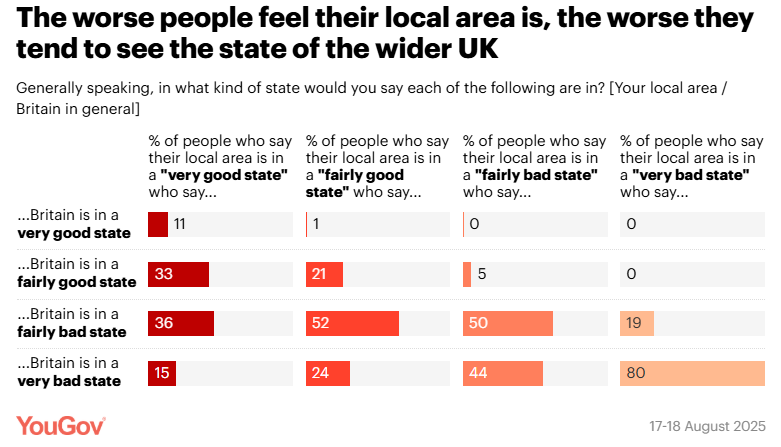
Source: YouGov - much more polling on this topic available at the link.
The government is looking to devolve more power through the English Devolution and Community Empowerment Bill before Parliament. But this must just be the start. As outlined in the report, we should use three principles as our guide to what happens over the coming decade.
Public Service Reform: bringing services like health, education and criminal justice closer to people with democratic accountability exercised through local leaders and local revenues
Fiscal Reform: giving places the revenues through devolved taxes or grants from national government to deliver their services
Constitutional Reform: abolishing the House of Lords and replacing it with a new upper chamber that builds place-based institutions into it
I won’t repeat the whole argument here, but would really encourage you to read the full piece if you have chance.
The biggest argument I often hear against this is the feared ‘postcode lottery’. The idea that things will differ between different places unless central government intervenes.
Well we already have a ‘postcode lottery’ - though it doesn’t look like much of a lottery. It is clear that if centralisation reduced the differences between places, then we would be the most regionally equal place in the world. Instead, we are one of the most unequal.1
We must empower places to get on with things in their area in a way central government never will.
In the report, I highlight the origin of the NHS. The battle between Bevan and Morrison over the foundation of the NHS was one about where control would lie - with Whitehall or with local areas. Attlee decided in favour of nationalising the system. And Bevan argued for this with the best of intentions, apparently saying that:
if a hospital bedpan is dropped in a hospital corridor in Tredegar, the reverberations should echo around Whitehall
The idea was that the concerns of ordinary people should be the concerns of an all powerful central government, fresh from defeating enemies in war and now looking to defeat social problems at home.
Instead what we see now is a cacophony of bedpans rattling down Whitehall. There have been positive moves to decentralise power in health and other areas, but more needs to be done - and in particular to create local democratic accountability.
Looking internationally, on health as in most areas, we remain centralised compared to other advanced economies. The OECD average for subnational spending on health as a percentage of GDP is 3.1%. In the UK, the figure is 0.2%.2
Learning from other countries, a more rational system looks to harness the power of communities within a national framework.3 This allows for local democracies to get on with things and innovate, whilst national government focus on the big issues and helping places. For health, this might mean GPs being managed at a more local level, integrated with public health services in neighbourhoods, while specialist hospital centres are managed nationally for example.
Getting to this position is not something that can be achieved in a single parliament. But now is the time to put the building blocks in place through the Devolution Bill and looking to build up capacity and capability in places.

This means working initially with the most established mayoral areas and their councils to create new local responsibilities for public services, whilst thinking nationally about revenues and a constitution fit for the modern era. A model that can then be applied across England, within a wider UK fiscal and constitutional settlement.
To do otherwise, is to ignore the evidence we see both internationally or from our own history. It is a mistake to think that our present model of unique centralisation is somehow uniquely placed to deliver. Instead, we must restore civic power, and with it the promise that every community can have pride and prosperity.
See the full report here. And also coverage in the Guardian via ‘Ministers could give mayors control of schools and hospitals in devolution shake-up’ and ‘Labour thinktank hopes Starmer will devolve more power to his potential rivals’.
Of all devolved mayors and Sadiq Khan, here in London
Couldn’t agree more.
Thus had been apparent for years! As population increases at an unregulated, non-managed pace across the country, services cannot keep up with demand. Youth services closed en masse under Tories have not recovered. Great work if ALL of the devolved mayors points the way. Wonderful